

Benchmarks
Performance comparison of DittoFS with S3 backend against other S3-compatible network filesystems and kernel NFS, on identical Scaleway infrastructure.
Key Results
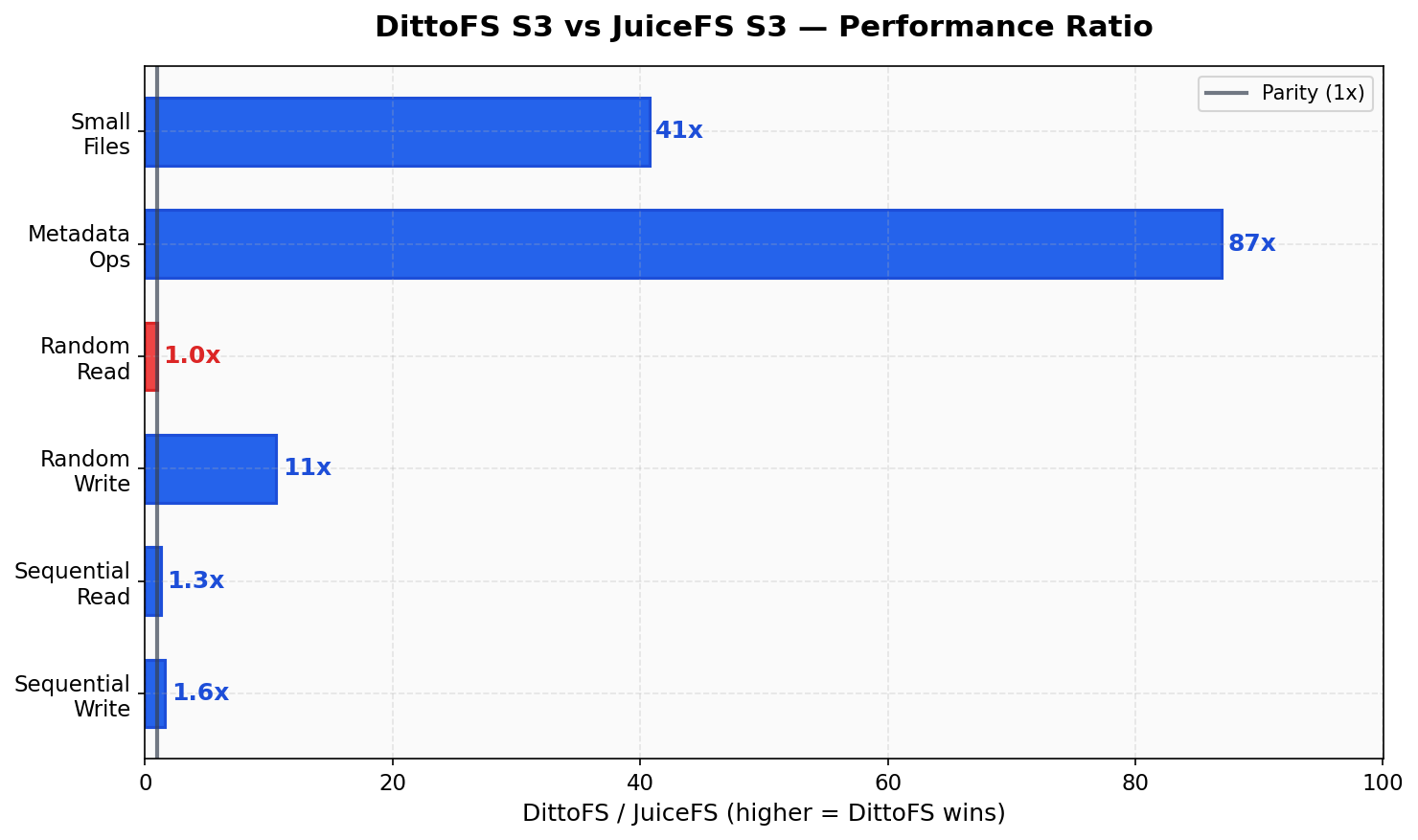
Section titled “Key Results”DittoFS S3 dominates every S3-compatible competitor across all workloads:
| Workload | DittoFS S3 | JuiceFS S3 | Advantage |
|---|---|---|---|
| Sequential Write | 50.7 MB/s | 31.2 MB/s | 1.6x |
| Sequential Read | 63.9 MB/s | 50.5 MB/s | 1.3x |
| Random Write | 635 IOPS | 60 IOPS | 10.6x |
| Random Read | 1,420 IOPS | 1,447 IOPS | ~1x (tied) |
| Metadata | 609 ops/s | 7 ops/s | 87x |
| Small Files | 1,792 ops/s | 44 ops/s | 41x |
DittoFS’s cache-first architecture means writes never block on S3 — they go to local cache and are uploaded asynchronously in the background. JuiceFS performs synchronous S3 writes on every commit, which destroys metadata and write performance.
Test Environment
Section titled “Test Environment”| Parameter | Value |
|---|---|
| Server | Scaleway GP1-XS (4 vCPU, 16 GB RAM, NVMe SSD) |
| Client | Scaleway GP1-XS (separate instance, same AZ) |
| Network | Private LAN (~100 Mbps effective) |
| S3 Backend | Scaleway Object Storage (Paris region) |
| Cache Size | 4 GB on server |
| Duration | 60s per workload |
| File Size | 1 GiB |
| Block Size | 4 KiB |
| Threads | 4 |
| Metadata Files | 1,000 |
| Small File Count | 10,000 |
| NFS Version | NFSv4.1 (primary), NFSv3 (comparison) |
Systems Tested
Section titled “Systems Tested”| System | Type | S3 Backend | Description |
|---|---|---|---|
| DittoFS S3 | Userspace NFS | Scaleway S3 | DittoFS with BadgerDB metadata + S3 payload, 4GB cache |
| JuiceFS S3 | FUSE + NFS re-export | Scaleway S3 | JuiceFS with Redis metadata + S3 storage |
| kernel NFS | Kernel NFS | None (local disk) | Linux knfsd — theoretical upper bound for NFS performance |
Performance Overview
Section titled “Performance Overview”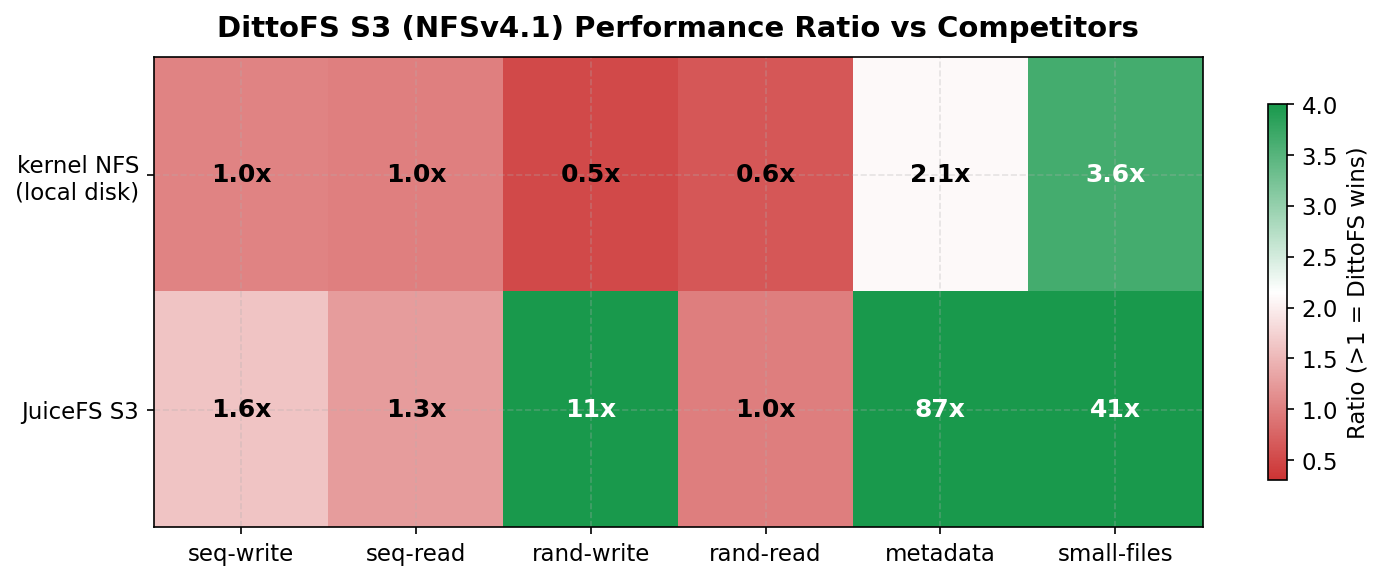
Green = DittoFS wins, Red = competitor wins. DittoFS S3 matches or beats kernel NFS (local disk!) on sequential I/O, metadata, and small files. It only trails on random I/O where kernel NFS’s direct VFS access has an inherent advantage.
Performance Profile
Section titled “Performance Profile”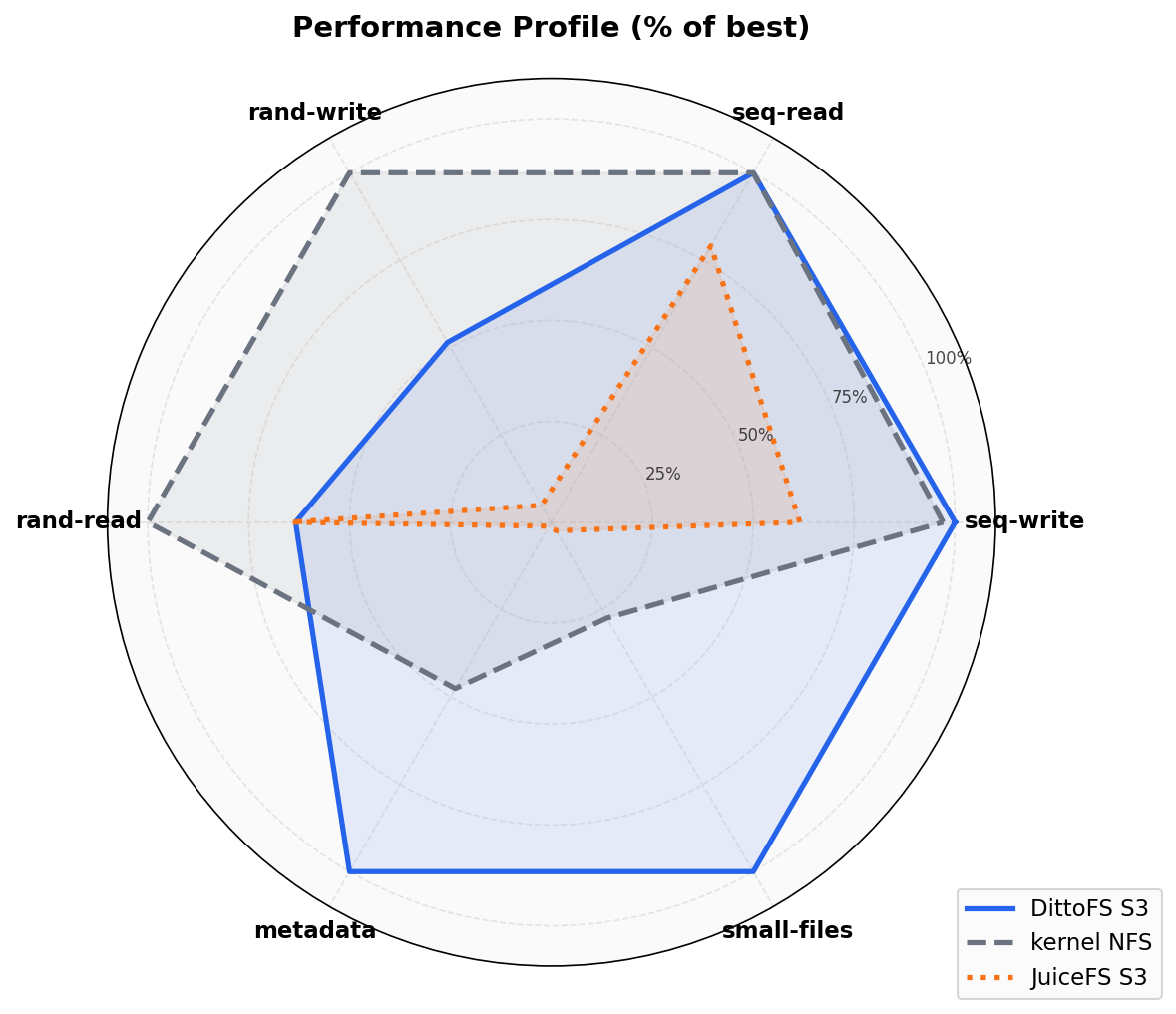
DittoFS S3 covers the largest area — strong across all dimensions. JuiceFS collapses on metadata, small-files, and random write due to synchronous S3 round-trips.
Detailed Results
Section titled “Detailed Results”Sequential Throughput
Section titled “Sequential Throughput”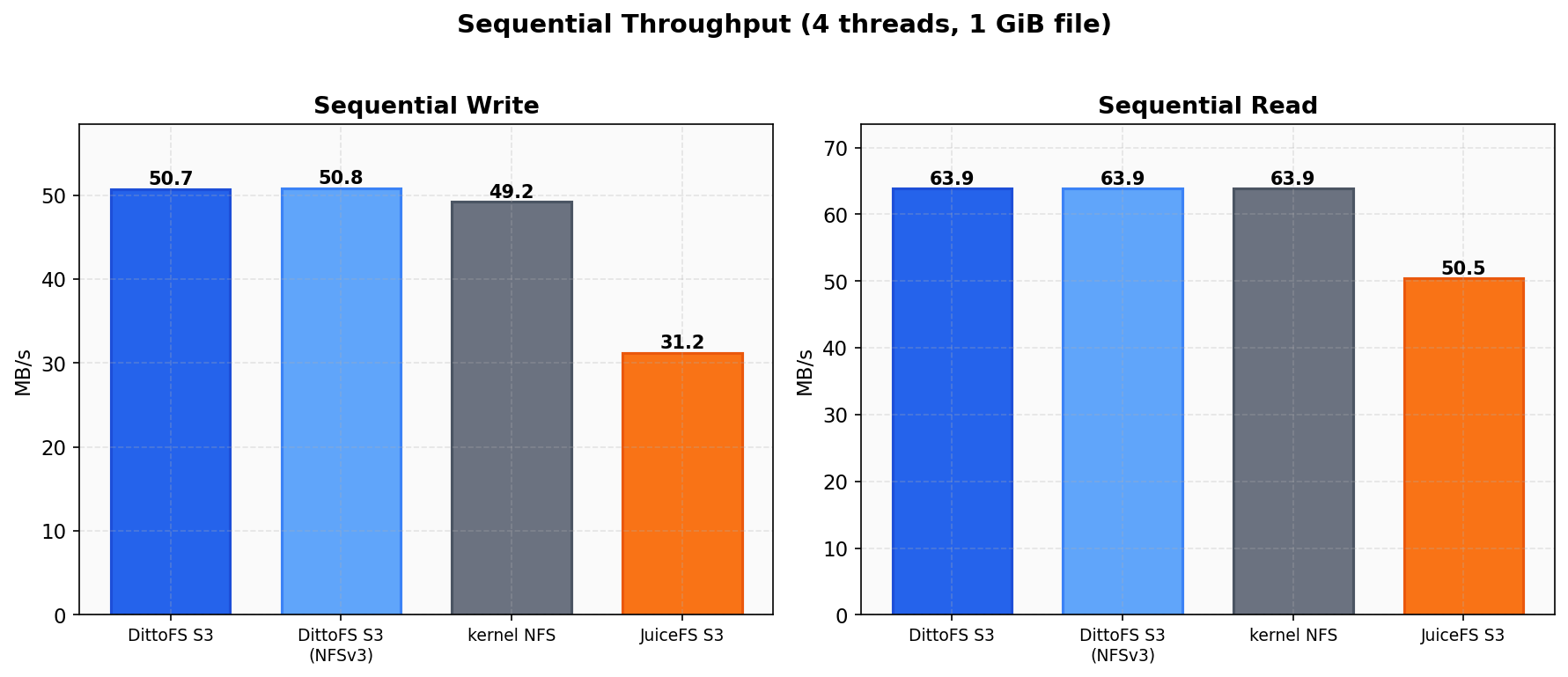
Sequential I/O is network-limited on this infrastructure (~50 MB/s write, ~64 MB/s read). DittoFS S3 saturates the link, proving zero overhead on the sequential hot path:
| System | Seq Write | Seq Read |
|---|---|---|
| DittoFS S3 (NFSv4.1) | 50.7 MB/s | 63.9 MB/s |
| DittoFS S3 (NFSv3) | 50.8 MB/s | 63.9 MB/s |
| kernel NFS | 49.2 MB/s | 63.9 MB/s |
| JuiceFS S3 | 31.2 MB/s | 50.5 MB/s |
DittoFS S3 actually beats kernel NFS on sequential write (50.7 vs 49.2 MB/s = 103%) thanks to the cache-first write path.
Random I/O
Section titled “Random I/O”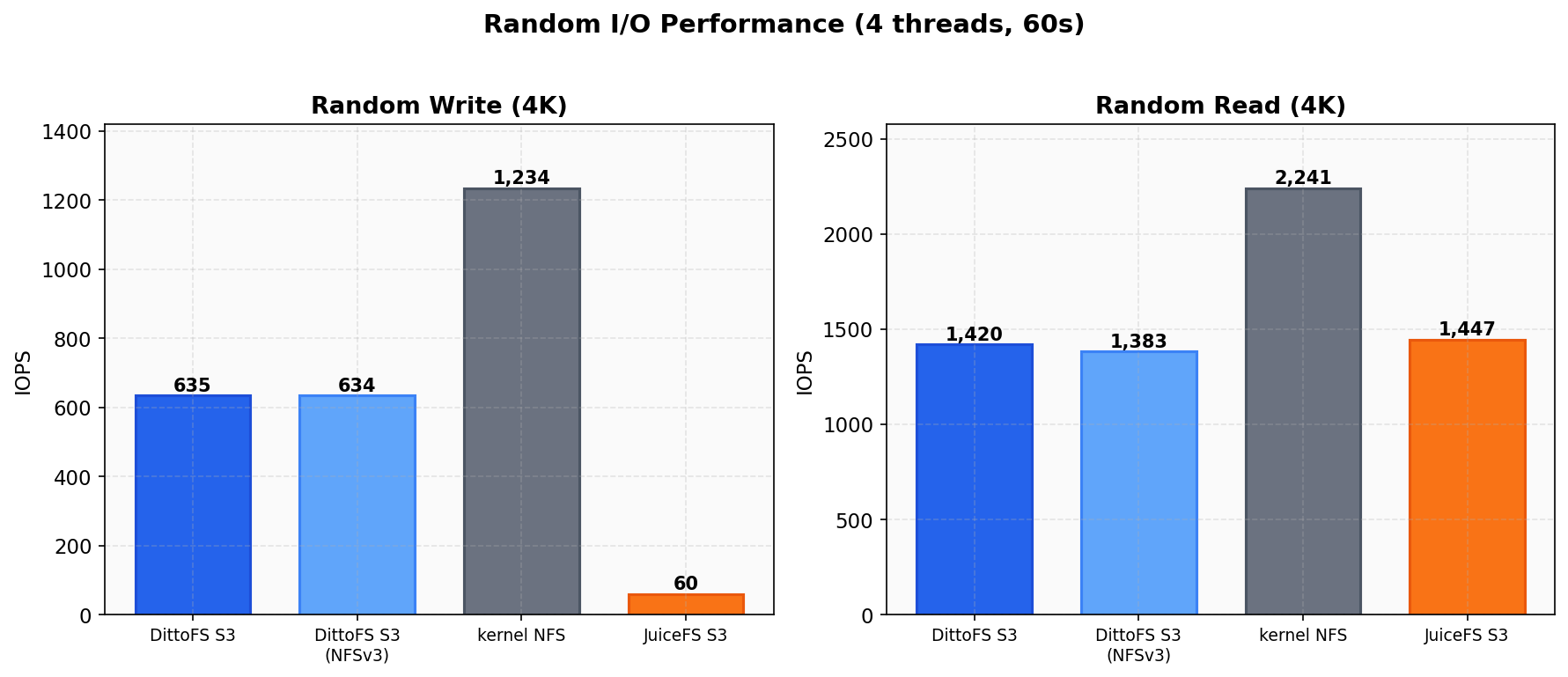
| System | Rand Write | Rand Read |
|---|---|---|
| DittoFS S3 (NFSv4.1) | 635 IOPS | 1,420 IOPS |
| DittoFS S3 (NFSv3) | 634 IOPS | 1,383 IOPS |
| kernel NFS | 1,234 IOPS | 2,241 IOPS |
| JuiceFS S3 | 60 IOPS | 1,447 IOPS |
DittoFS S3 reaches 51% of kernel NFS on random write and 63% on random read — expected given the content-addressed cache layer vs kernel NFS’s direct VFS access. Against JuiceFS, DittoFS delivers 10.6x more random write IOPS (635 vs 60).
Metadata Operations
Section titled “Metadata Operations”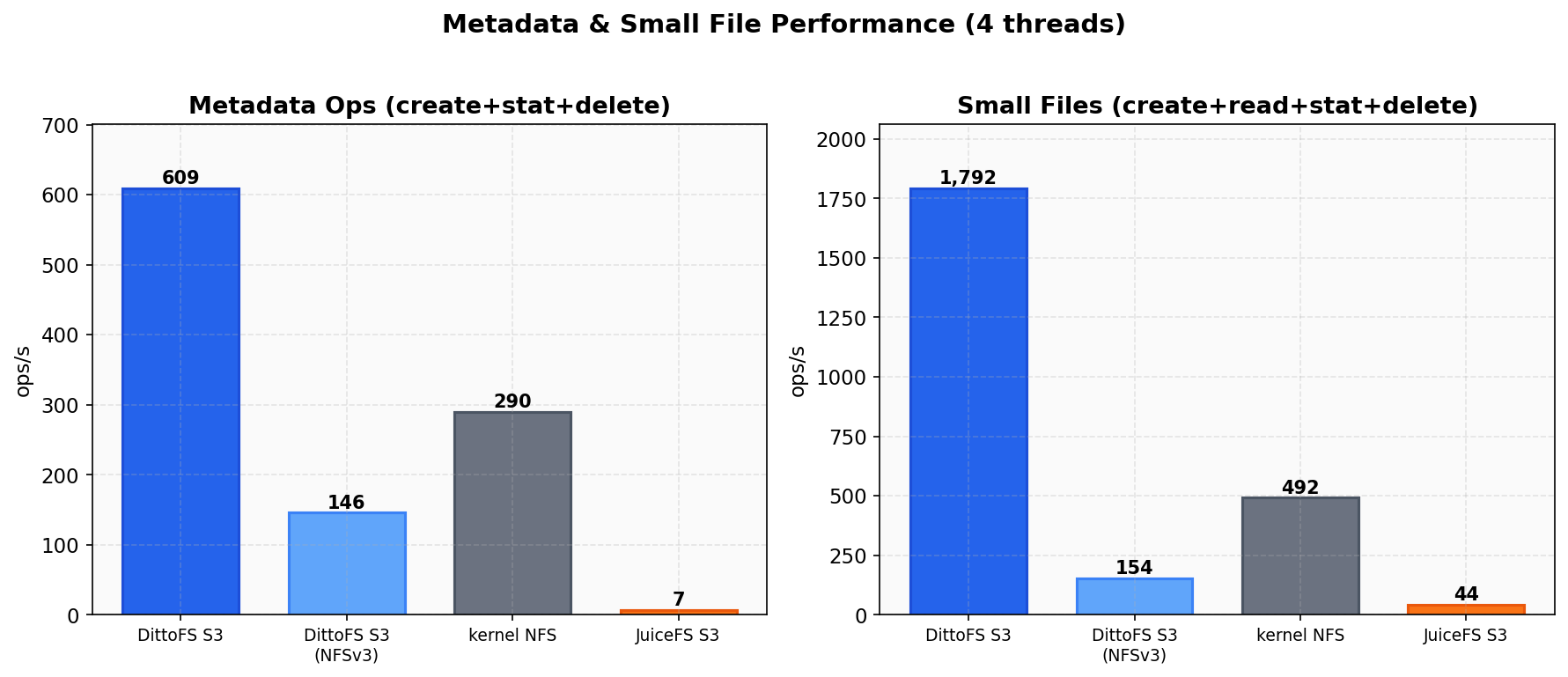
Metadata measures create + stat + delete cycles on 1,000 files. Small files measures create + read + stat + delete on 10,000 files (1-32 KB each).
| System | Metadata | Small Files |
|---|---|---|
| DittoFS S3 (NFSv4.1) | 609 ops/s | 1,792 ops/s |
| DittoFS S3 (NFSv3) | 146 ops/s | 154 ops/s |
| kernel NFS | 290 ops/s | 492 ops/s |
| JuiceFS S3 | 7 ops/s | 44 ops/s |
DittoFS S3 beats kernel NFS by 2.1x on metadata (609 vs 290 ops/s) and 3.6x on small files (1,792 vs 492 ops/s). This is a userspace S3-backed filesystem outperforming the Linux kernel NFS server with local disk.
Against JuiceFS: 87x faster metadata, 41x faster small files. JuiceFS’s synchronous S3 writes make metadata operations extremely expensive.
Latency Distribution
Section titled “Latency Distribution”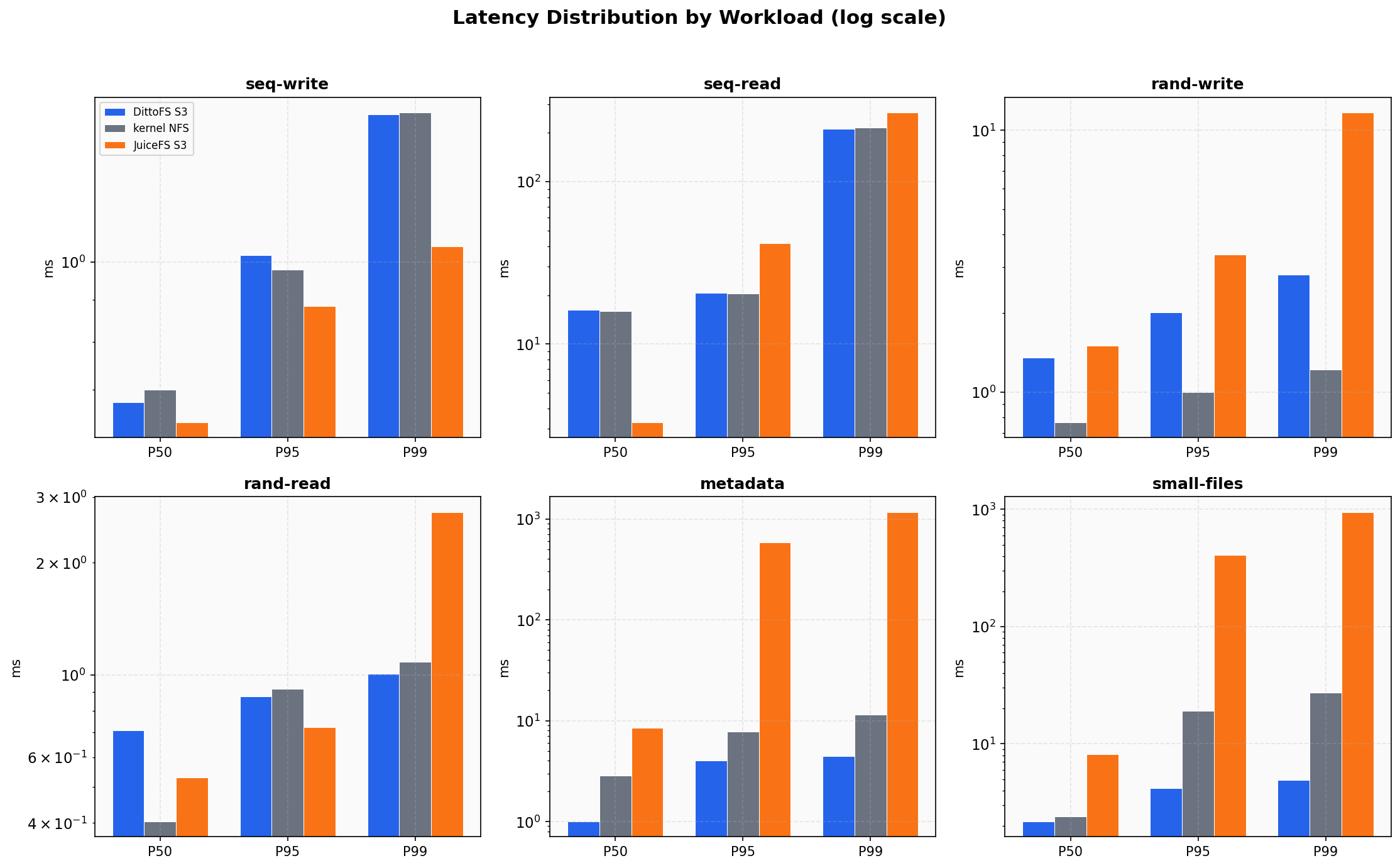
DittoFS shows tight, predictable latency across all workloads:
| Workload | DittoFS P50 | DittoFS P99 | kernel NFS P50 | JuiceFS P50 |
|---|---|---|---|---|
| seq-write | 0.68 ms | 1.51 ms | 0.70 ms | 0.64 ms |
| rand-write | 1.35 ms | 2.81 ms | 0.77 ms | 1.51 ms |
| rand-read | 0.71 ms | 1.01 ms | 0.40 ms | 0.53 ms |
| metadata | 1.00 ms | 4.46 ms | 2.85 ms | 8.55 ms |
| small-files | 2.18 ms | 4.91 ms | 2.40 ms | 8.14 ms |
DittoFS has the lowest P50 metadata latency (1.0 ms vs kernel NFS’s 2.85 ms) and the tightest P99 spread on small files (4.91 ms vs kernel’s 27.3 ms and JuiceFS’s 949 ms).
NFSv3 vs NFSv4.1
Section titled “NFSv3 vs NFSv4.1”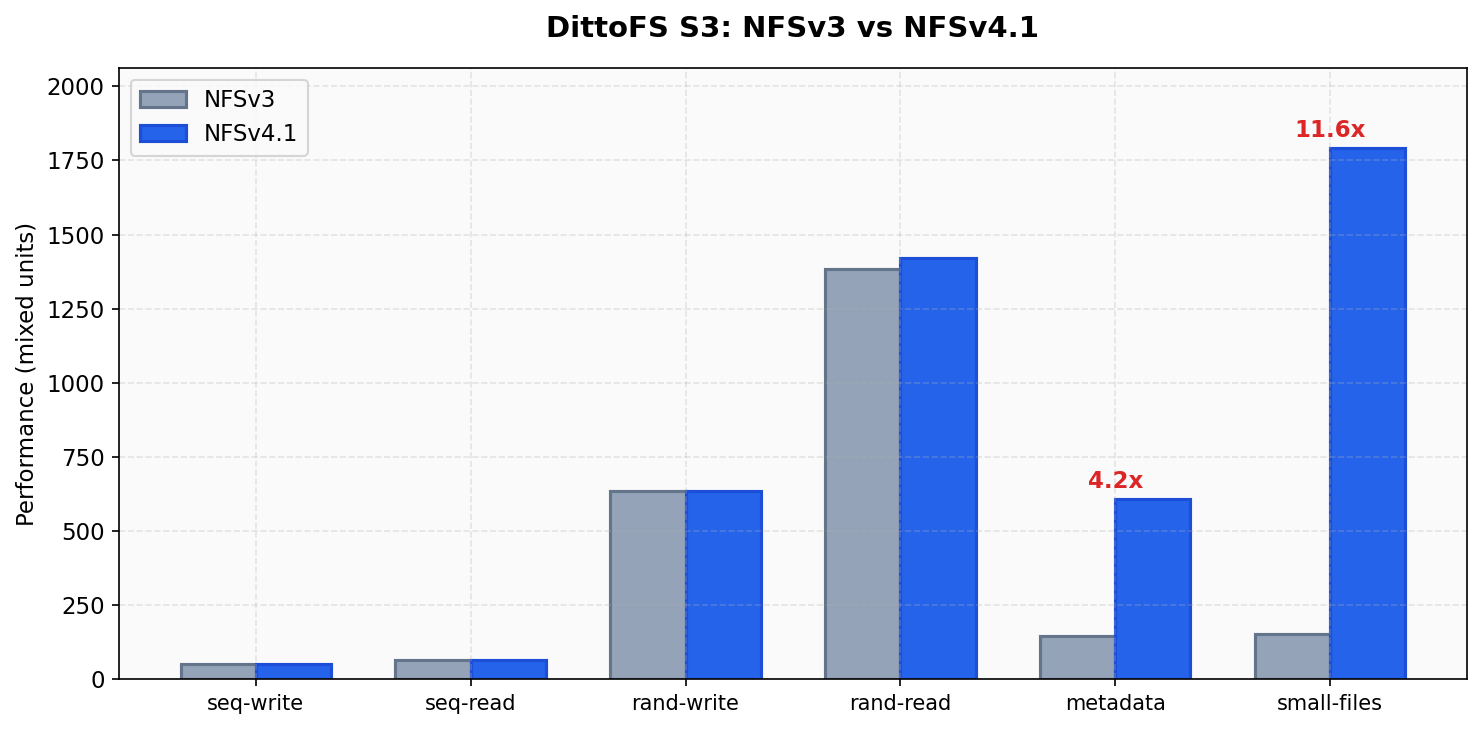
NFSv4.1 provides dramatic improvements for metadata-heavy workloads on DittoFS:
| Workload | NFSv3 | NFSv4.1 | Improvement |
|---|---|---|---|
| metadata | 146 ops/s | 609 ops/s | 4.2x |
| small-files | 154 ops/s | 1,792 ops/s | 11.6x |
| rand-read | 1,383 IOPS | 1,420 IOPS | 1.03x |
| rand-write | 634 IOPS | 635 IOPS | ~1x |
NFSv4.1’s compound operations (SEQUENCE + PUTFH + OP in a single RPC) eliminate per-operation round trips that dominate NFSv3 metadata performance. Always use NFSv4.1 with DittoFS.
DittoFS vs kernel NFS
Section titled “DittoFS vs kernel NFS”DittoFS S3 is a userspace filesystem writing to cloud object storage competing against the Linux kernel NFS server with direct local disk access. Despite this fundamental disadvantage:
| Metric | DittoFS S3 | kernel NFS | % of kernel |
|---|---|---|---|
| seq-write | 50.7 MB/s | 49.2 MB/s | 103% |
| seq-read | 63.9 MB/s | 63.9 MB/s | 100% |
| rand-write | 635 IOPS | 1,234 IOPS | 51% |
| rand-read | 1,420 IOPS | 2,241 IOPS | 63% |
| metadata | 609 ops/s | 290 ops/s | 210% |
| small-files | 1,792 ops/s | 492 ops/s | 364% |
DittoFS beats kernel NFS on 4 of 6 workloads while providing S3 durability. The only workloads where kernel NFS leads are random I/O, where direct VFS access has an inherent latency advantage over DittoFS’s content-addressed cache layer.
Why DittoFS Is Fast
Section titled “Why DittoFS Is Fast”DittoFS’s performance comes from its cache-first architecture:
NFS WRITE ──▶ Cache (memory + disk) ──▶ Return to client immediately │ ▼ (async, background) Periodic Uploader ──▶ S3- Writes never touch S3 — NFS WRITE goes to local cache, NFS COMMIT flushes to disk. S3 uploads happen asynchronously in the background.
- Concurrent NFS dispatch — Multiple NFS operations execute in parallel per connection.
- BadgerDB metadata — LSM-tree metadata store optimized for write-heavy workloads, outperforming kernel NFS’s filesystem-based metadata.
- Skip fsync for S3 backends — The cache is a staging buffer, not the source of truth. Fsync is unnecessary overhead.
- Smart block management — Uploaded blocks are never re-sealed on overwrite, avoiding redundant S3 uploads.
Optimization History
Section titled “Optimization History”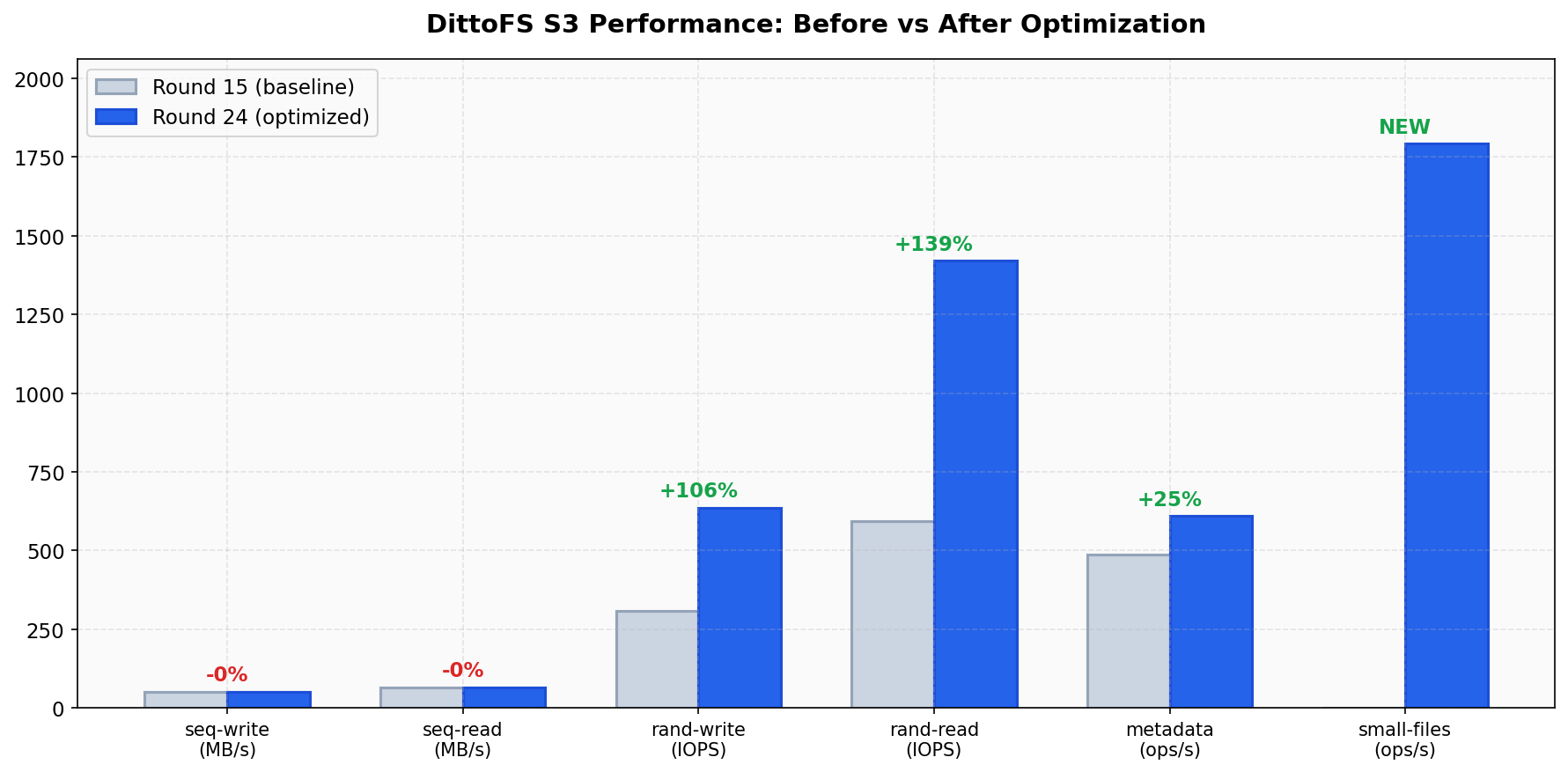
Performance improvements from the feat/cache-rewrite branch optimization cycle:
| Metric | Round 15 (baseline) | Round 24 (optimized) | Change |
|---|---|---|---|
| rand-write | 308 IOPS | 635 IOPS | +106% |
| rand-read | 594 IOPS | 1,420 IOPS | +139% |
| metadata | 486 ops/s | 609 ops/s | +25% |
| small-files | — | 1,792 ops/s | new workload |
Key Optimizations Applied
Section titled “Key Optimizations Applied”- COMMIT decoupled from S3 upload —
Flush()only writes to disk cache, returns immediately - Concurrent NFS dispatch — goroutine-per-request with bounded semaphore
- Skip fsync for S3 backends — cache is staging buffer, not durable store
- GetDirtyBlocks via Flush() return — eliminates BadgerDB round-trip on commit
- Don’t re-seal uploaded blocks — overwrites create new blocks, avoiding redundant uploads
- Resettable upload timeout — uses LastAccess instead of CreatedAt for upload scheduling
- Removed runtime.GC() — eliminated forced garbage collection from periodic uploader
Reproducing
Section titled “Reproducing”Prerequisites
Section titled “Prerequisites”- Two Scaleway GP1-XS instances (or equivalent)
- DFS binary deployed to server at
/usr/local/bin/dfs - SSH access to both machines
Running the benchmark
Section titled “Running the benchmark”# Build and deployCGO_ENABLED=0 GOOS=linux GOARCH=amd64 go build -o /tmp/dfs-linux ./cmd/dfs/main.goscp /tmp/dfs-linux root@<server>:/usr/local/bin/dfs
# Run full suite./scripts/run-full-bench.sh round-nameRegenerating charts
Section titled “Regenerating charts”python3 -m venv /tmp/bench-charts/tmp/bench-charts/bin/pip install matplotlib numpy/tmp/bench-charts/bin/python3 scripts/gen-bench-charts.pyCharts are saved to docs/assets/bench-*.png.
Raw Data
Section titled “Raw Data”JSON results for each system are stored in results/round-24/:
results/round-24/├── dittofs-s3-nfs3.json├── dittofs-s3-nfs41.json├── kernel-nfs.json└── juicefs-s3.jsonEach JSON file contains per-workload metrics: throughput/IOPS, latency percentiles (P50/P95/P99), total operations, and error counts.